In short
Before you borrow to get to payday, list what must be paid now, ask about moving a bill, and check what your next paycheque leaves after repayment.
On this page
- First, work out what “$200 short” actually means
- Ask about moving a payment before assuming you can’t
- Check other options without counting on them
- Now ask: “What will I have left on Friday?”
- A $200 loan: what the next paycheque could look like
- What if the worksheet leaves you short again?
- If you decide to borrow, check these details before signing
- Make the decision with Friday’s budget in front of you
- Quick questions
It’s Tuesday. You have $46 in your account, payday is Friday, and there’s roughly $250 worth of things that need paying before then.
Some of it is groceries. Some is getting to work. There’s a bill due tomorrow, too.
You don’t need someone telling you to cancel a subscription or start an emergency fund. You need to work out what to do with the next three days.
Before you borrow $200, there are two questions worth answering:
- What actually has to be paid before Friday?
- What will be left of Friday’s paycheque after you deal with it?
Start there, not with the application.
First, work out what “$200 short” actually means
A bank balance tells you how much money you have. It doesn’t tell you which expenses can wait, which payments are already scheduled, or whether the amount you need is really $200.
Open your banking app and list everything that needs money between now and payday. Include automatic withdrawals you may have forgotten about.
Keep it simple:
| Expense | Amount | Due before Friday? | What to check |
|---|---|---|---|
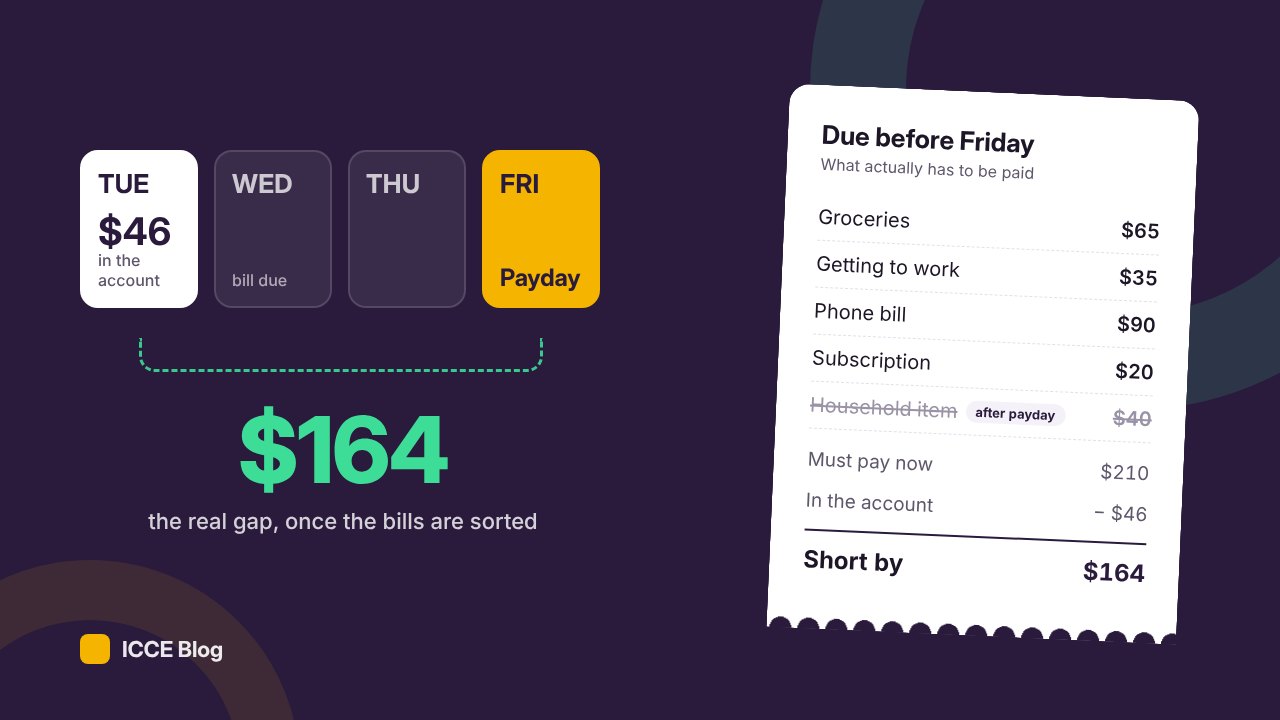
| Groceries to last until payday | $65 | Yes | What do you need for the next few days? |
| Transportation to work | $35 | Yes | What will the remaining trips actually cost? |
| Phone bill | $90 | Yes | Can the provider agree to a different payment date? |
| Household purchase | $40 | No | Can it wait until after payday? |
| Subscription renewal | $20 | Yes | Can you pause it before the charge, and do you need it? |
In this example, everything adds up to $250. With $46 available, the apparent gap is $204.
But the household purchase isn’t due before payday. Taking it out of this week’s list brings the gap down to $164.
That doesn’t solve the problem. It does give you a more accurate number.
Before you cross anything else off, check the consequences. A payment that looks less urgent could still involve a service interruption, a contractual obligation, or a charge if it’s missed.
The aim is not to ignore bills. It’s to stop treating every expense as though it has the same deadline.
Ask about moving a payment before assuming you can’t
One useful call may be to the company expecting payment.
The Financial Consumer Agency of Canada lists asking for more time to pay bills among the options to consider before taking out a payday loan. That doesn’t mean a provider must agree, but it makes the question worth asking.
You don’t need a long explanation. Try:
“My payment is due Wednesday, but I’m paid on Friday. Can we arrange for me to pay on Friday instead? Before I agree, could you tell me whether there would be any fees or effect on my service?”
If paying part now would be manageable:
“I can pay $30 today and the remaining $60 on Friday. Would you accept that as a payment arrangement? What would happen to the account in the meantime?”
Before ending the conversation, ask:
- What exact amount must I pay, and by what date?
- Would there be a late fee or another charge?
- Would my service remain active?
- Would an automatic withdrawal still go through?
- Would there be any effect on my credit reporting?
- Can you send the arrangement in writing?
Don’t assume that making a partial payment changes the original agreement. Ask the provider to explain what it has accepted and keep the confirmation.
Also remember: moving a $90 bill to Friday doesn’t make it disappear. It moves that $90 into Friday’s budget.
That distinction matters in the next step.
Check other options without counting on them
Before committing to a payday loan, check whether you have another workable way to cover the gap.
Depending on your circumstances, that might mean asking your employer about a pay advance, discussing a payment arrangement, or checking the cost of credit you already have available. FCAC identifies these and other alternatives for consumers to consider, including some options that may cost less than a payday loan.
Availability is the catch.
An employer may not offer advances. A credit application may not be approved. Help from family may not be possible, or comfortable.
Treat an option as available only once you know:
- How much money it would provide or free up.
- When it would actually be available.
- What it would cost.
- When you would need to repay it.
For an employer advance, for example, ask what will be deducted from your next pay. Otherwise, you could solve Tuesday’s problem without noticing what it does to Friday.
Now ask: “What will I have left on Friday?”
This is the most important part of the decision.
Being able to repay a loan is not quite the same as being able to repay it and cover your regular expenses. FCAC specifically advises checking both before taking a payday loan.
Use the date of your following payday as the end of your budget, not Friday night.
Your next-paycheque worksheet
| Item | Your amount |
|---|---|
| Expected take-home pay on Friday | $______ |
| Plus money you genuinely expect to have left | $______ |
| Minus housing costs due before the following payday | − $______ |
| Minus groceries and household essentials | − $______ |
| Minus transportation | − $______ |
| Minus utilities, phone, childcare or other essentials | − $______ |
| Minus existing debt payments and automatic withdrawals | − $______ |
| Minus any bills you moved to Friday | − $______ |
| Minus the proposed loan repayment due in this period | − $______ |
| Money remaining until the following payday | $______ |
Use the repayment amount and date from the actual loan agreement. Don’t assume a particular schedule applies to every loan.
If you haven’t seen an agreement yet, how ICCE works explains what happens after you apply. But it’s the lender’s written terms you need for this calculation.
A $200 loan: what the next paycheque could look like
Here’s a fictional example.
Suppose your take-home pay on Friday is $1,100. Your expenses between Friday and the following payday total $850, before dealing with the current $200 shortfall.
That leaves $250.
Now compare two ways of addressing the shortfall.
| Friday’s budget | An agreed $200 bill deferral | A $200 loan |
|---|---|---|
| Take-home pay | $1,100 | $1,100 |
| Other expenses until the following payday | − $850 | − $850 |
| Deferred bill now due | − $200 | $0 |
| Loan repayment | $0 | − $228 |
| Money remaining | $50 | $22 |
The deferral option only works if the shortfall involves a bill that the provider agrees to move. It won’t buy groceries or cover a bus fare.
The loan option provides money now, but in this example leaves only $22 after the listed expenses.
Neither column tells you what to do. It shows the trade-off clearly enough to judge it.
Ask yourself: is anything missing from that $850? A prescription? A school expense? A payment that comes out every other week?
If there’s a predictable expense missing, put it in before deciding.
Cancellation windows, loan limits and repayment rules differ by province, so check the rules where you live rather than relying on a general example.
What if the worksheet leaves you short again?
If the repayment leaves you unable to cover essentials, the worksheet has done its job. It has shown you the problem before you commit.
Go back through the numbers:
- Is the amount you need smaller than you first thought?
- Is there a payment arrangement you haven’t asked about?
- Have you included an expense that genuinely falls after the following payday?
- Is there a lower-cost option actually available to you?
- Are you relying on overtime, a refund or another payment that hasn’t been confirmed?
Don’t improve the result by removing groceries you will still need or counting income you’re not sure you’ll receive.
And if this same shortfall keeps returning every payday, treat that as a different problem from a one-off expense. A short repayment period and high borrowing costs can make repeated payday borrowing difficult to escape.
A useful budget needs to be honest, not optimistic.
If you decide to borrow, check these details before signing
Before accepting a loan, make sure you can identify:
- The amount you will receive.
- The total amount you must repay.
- Every repayment date.
- How payments will be collected.
- What happens if a payment is missed or returned.
- Whether the lender is licensed where you live.
FCAC recommends dealing with a licensed payday lender, reading the agreement carefully, and asking about anything you don’t understand. Missed payments can lead to additional fees and interest.
If a repayment figure or withdrawal date is unclear, get an answer before signing, not after the money arrives. Our payday loan FAQ covers common questions about cost, cancelling and repayment.
Make the decision with Friday’s budget in front of you
Being $200 short is stressful enough without turning it into a judgement about how you handle money.
Write down what must be paid now. Ask whether anything can be rearranged. Then put the full repayment into the next pay period and see what remains.
The useful number isn’t just how much you can borrow.
It’s what you will have left afterward.
Quick questions
How much does a $200 payday loan cost in Canada?
In provinces with a federally designated payday lending regime, the most a licensed lender can charge is $14 per $100 borrowed. On $200, that’s $28, so you would repay up to $228.
Can I ask a company to move my bill’s due date?
Yes. Many providers will discuss a new date or a partial payment if you call before the bill is due. They don’t have to agree, so ask about fees and get the arrangement in writing.
What if I’m short every payday?
A shortfall that comes back every pay period is usually a budget problem rather than a timing problem, and repeat borrowing tends to make it worse. A non-profit credit counsellor can go through your full budget with you at no cost.

The ICCE Editorial Team writes plain-language guides to borrowing in Canada, based on federal and provincial rules and guidance from consumer protection regulators.